
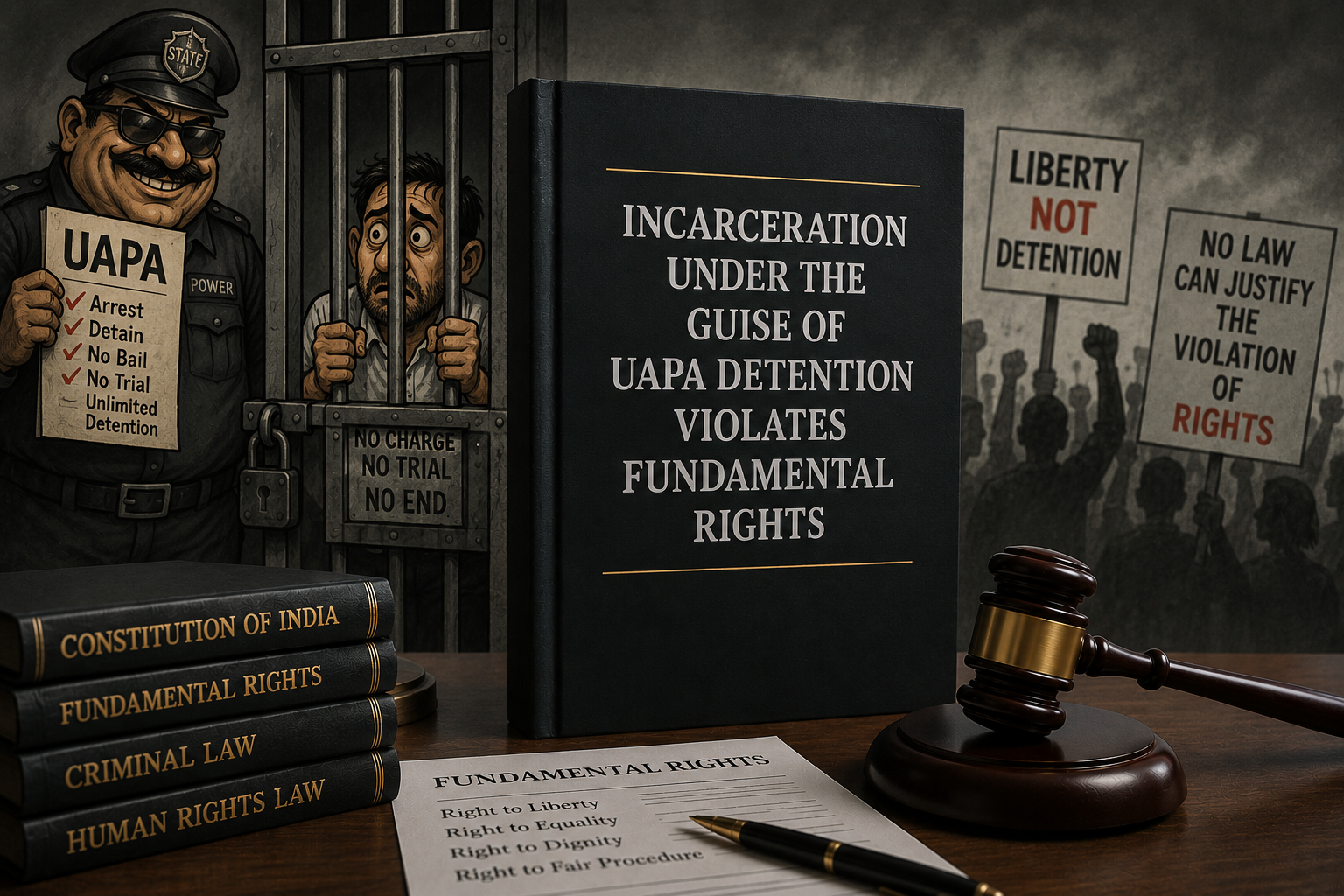
UAPA Detention Without Trial: When Does It Cross Constitutional Limits?
Examining how courts are recalibrating the balance between national security concerns and the fundamental right to personal liberty under Article 21.
The Unlawful Activities (Prevention) Act, 1967 ("UAPA") contains Section 43D(5), which imposes a stringent restriction on bail:
"Notwithstanding anything contained in the Code, no person accused of an offence punishable under Chapters IV and VI of this Act shall... be released on bail... Provided that such accused person shall not be released on bail... if the Court, on a perusal of the case diary or the report made under section 173 of the Code is of the opinion that there are *reasonable grounds for believing that the accusation against such person is prima facie true"
Additionally, Section 43D(4) bars the application of Section 438 CrPC (anticipatory bail) entirely, and Section 43D(2) extends the maximum period of investigation custody to 90 days (extendable up to 180 days).
The central question is whether prolonged incarceration without trial under this regime, or denial of bail solely because one is booked under UAPA, violates Article 21 (right to life and personal liberty, including the right to a speedy trial) and Article 14 (equality before law / non-arbitrariness).
The Development of Law
1. The Strict Threshold — NIA v. Zahoor Ahmad Shah Watali [(2019) 5 SCC 1] <cite>2</cite>
In this early post-2008-amendment decision, the Supreme Court reversed the High Court's grant of bail, holding that under Section 43D(5) the court must assess the "totality of material on broad probabilities" to determine whether the accusation is prima facie true. The Court found the High Court had impermissibly conducted a "mini-trial" and discarded crucial evidence. Watali set a steep bar: the accused must show the accusation is not prima facie true.
2. The Constitutional Override — Union of India v. K.A. Najeeb [(2021) 3 SCC 713]
This was the watershed moment. A three-Judge Bench, faced with an accused who had spent over 5 years in custody with 276 witnesses still to be examined, declared:
"The presence of statutory restrictions like Section 43-D(5) of the UAPA per se does not oust the ability of the constitutional courts to grant bail on grounds of violation of Part III of the Constitution..Whereas at commencement of proceedings, the courts are expected to appreciate the legislative policy against grant of bail but the rigours of such provisions will melt down where there is no likelihood of trial being completed within a reasonable time and the period of incarceration already undergone has exceeded a substantial part of the prescribed sentence."*
The Court also noted that UAPA's Section 43D(5) is "comparatively less stringent" than Section 37 NDPS because UAPA lacks the "prima facie not guilty" condition — supporting a more flexible judicial approach.
Held: Section 43D(5) does NOT override constitutional courts' power to grant bail when Article 21 rights are infringed by prolonged pre-trial detention.
3. Ashim @ Asim Kumar Haranath Bhattacharya v. NIA [[2021] 9 SCR 607] <cite>4</cite>
The accused was in custody for 9.5 years under UAPA. The Supreme Court granted bail, holding:
- The trial had barely commenced despite nearly a decade
- The accused's age (74 years) was a material factor
- K.A. Najeeb applied with full force
4. Satender Kumar Antil v. CBI [(2022) 10 SCC 51]
Though not a UAPA case, the Court held that Section 436A CrPC (mandating release if trial not completed within specified incarceration periods) applies to Special Acts as well in the absence of contrary provisions.
5. Mohd. Muslim @ Hussain v. State (NCT of Delhi) [[2023] 3 SCR 697]
An NDPS case extending the Najeeb logic:
"Laws which impose stringent conditions for grant of bail, may be necessary in public interest; yet, if trials are not concluded in time, the injustice wrecked on the individual is immeasurable."
6. Javed Gulam Nabi Shaikh v. State of Maharashtra [(2024) 9 SCC 813]
A UAPA case — the accused was in custody for 4 years; charges had not even been framed, with 80 prosecution witnesses to be examined. The Supreme Court granted bail, holding:
"Howsoever serious a crime may be, an accused has the right to speedy trial under Article 21... keeping persons behind the bars for unlimited periods of time in the hope of speedy completion of trial would deprive the fundamental right of persons under Article 21."
7. Sheikh Javed Iqbal @ Ashfaq Ansari v. State of Uttar Pradesh [(2024) 8 SCC 293]
The accused was a foreign national facing UAPA + IPC charges, in custody for over 9 years with only 2 witnesses examined. The Supreme Court categorically held:
"The restrictions on bail under Section 43D(5) of the UAP Act do not override the constitutional right to speedy trial in cases of prolonged incarceration."
The Court distinguished Zahoor Watali — clarifying that Watali's strict approach applies only where there is no excessive delay, not where incarceration has become punitive.
8. Athar Parwez v. Union of India [[2024] 12 SCR 1093]
The accused was in custody for 2 years 4 months, charges not framed, with 354 witnesses to be examined. The Supreme Court granted bail, applying K.A. Najeeb and Javed Shaikh, holding that Article 21 would stand violated if the accused were allowed to languish indefinitely without trial.
9. Harpreet Singh Talwar @ Kabir Talwar v. State of Gujarat [[2025] 6 SCR 291]
"The rigour of Section 43D(5) of the UAPA would, however, in an appropriate case yield to the overarching mandate of Article 21 of the Constitution, especially where the trial is inordinately delayed or where prolonged incarceration has been suffered."
Syed Iftikhar Andrabi Vs NIA, Jammu [(2026) INSC 503]
Affirmed K.A. Najeeb (Supra) and observed as follows
"Therefore, the caution of Najeeb is that continued incarceration cannot go unabated by a mere discharge by the State of the prima facie standard under Section 43-D(5). The judgment explicitly held that Section 43-D(5) will ‘melt down’ where prolonged incarceration and delayed trial produce a violation of Article 21. The constitutional inquiry in Najeeb therefore operated independent of, and notwithstanding, the statutory embargo of Section 43-D(5) in the realm of constitutional principles"
Distinguishing judgement had been rendered by the Supreme Court
Gurwinder Singh Vs. State of Punjab (2024) 5 SCC 403
The Bench held that Section 43-D(5) of the UAP Act imposes an independent and stringent restriction on the ordinary discretion of courts to grant bail. It observed that, unlike the general principle of criminal jurisprudence where “bail is the rule and jail the exception,” the legislative scheme of the UAP Act reflects the converse approach — namely, that bail should ordinarily be denied — and that courts are bound to give effect to this intent. The judgment consequently evolved what it termed a “twin-prong test” for the grant of bail under the UAP Act.
What is this Twin-prong test:
First, whether the accusation is prima facie true; and
Second, only if the first question is answered in favour of the accused, whether ordinary bail considerations, such as, flight risk, tampering with evidence, or influencing witnesses, justify release.
Problem with the test: The State need only to satisfy a low prima facie threshold while the trial may continue for years with the result that pre-trial incarceration begins to acquire a post-trial punitive character and even then, no court could ever grant bail no matter the length of period of such incarceration because the case stood prima facie made out against the accused. (Syed Iftikhar Andrabi Vs NIA, Jammu [(2026) INSC 503])
Both Situations Violate Fundamental Rights
-Prolonged Incarceration Without Trial under UAPA
Yes, it is violative of Article 21. The law has decisively moved from the strict Zahoor Watali approach to the K.A. Najeeb constitutional override. The rigour of Section 43D(5) "melts down" where:
1. No likelihood of trial completion within a reasonable time — e.g., hundreds of witnesses, slow progress, systemic delays
2. Incarceration exceeds a substantial part of the prescribed sentence — for UAPA, the maximum sentence is typically 7 years to life; incarceration of 2–4+ years without trial commencement is increasingly treated as violative
3. Trial has not meaningfully progressed — charges not framed, minimal witness examination
The courts have harmonised the statutory provision with Article 21: Section 43D(5) applies at the threshold but yields to the overarching constitutional guarantee of speedy trial.
-Denial of Bail Solely Because Accused is Booked under UAPA
Yes, this is impermissible and arbitrary. Denying bail merely because the accused faces UAPA charges, without:
- Examining the totality of material to assess whether the accusation is prima facie true (the Watali threshold)
- Considering the period of detention already undergone (the Najeeb factor)
- Evaluating the stage and progress of trial (the Parwez factor)
- Applying the individualised facts of the case
...would violate Article 14 (arbitrary exercise of power) and Article 21 (personal liberty). The label "UAPA" cannot be a magic wand to justify indefinite incarceration. As held in Western Coal Fields Ltd. v. Manohar Fulzele [[2025] 1 SCR 911]: "Merely because a statute imposes limitations on grant of bail, the same would not per se oust the jurisdiction of a Constitutional Court to grant bail."
The Current Synthesis
Threshold test - Court must assess if accusation is prima facie true (totality of material)
Constitutional override - Section 43D(5) yields to Article 21 when trial is delayed
Minimum incarceration for bail - No fixed minimum; 2+ years with no substantial trial progress increasingly justifies bail
Who can grant - Constitutional courts (High Courts and Supreme Court) — Special Courts apply Section 43D(5) strictly
Mechanical denial - Impermissible — each case requires individualised assessment
Authorities Cited
Section 43D, Unlawful Activities (Prevention) Act, 1967
NIA v. Zahoor Ahmad Shah Watali, (2019) 5 SCC 1
Union of India v. K.A. Najeeb, (2021) 3 SCC 713
Ashim @ Asim Kumar Haranath Bhattacharya v. NIA, [2021] 9 SCR 607
Satender Kumar Antil v. CBI, (2022) 10 SCC 51
Mohd. Muslim @ Hussain v. State (NCT of Delhi), [2023] 3 SCR 697
Javed Gulam Nabi Shaikh v. State of Maharashtra, (2024) 9 SCC 813
Sheikh Javed Iqbal @ Ashfaq Ansari v. State of Uttar Pradesh, (2024) 8 SCC 293
Athar Parwez v. Union of India, [2024] 12 SCR 1093
Harpreet Singh Talwar @ Kabir Talwar v. State of Gujarat, [2025] 6 SCR 291
Gurwinder Singh Vs. State of Punjab (2024) 5 SCC 403
Syed Iftikhar Andrabi Vs NIA, Jammu (2026) INSC 503
Comments
Leave a comment
Comments are reviewed before publishing.