
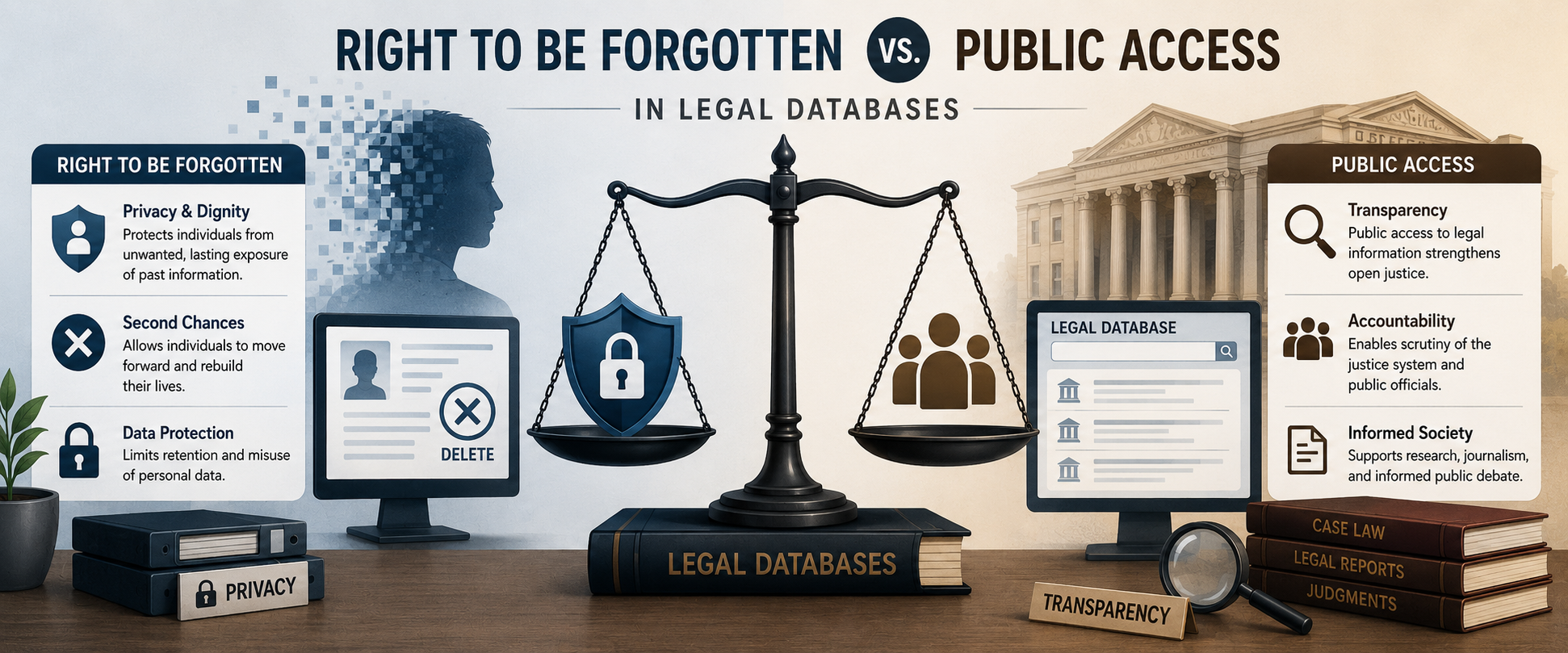
Right to Be Forgotten vs. Public Access in Legal Databases
Analyzing the conflict between anonymizing party names and the public's right to access justice with relevant case laws.
The Constitutional Tension: Erasure of Party Names from Legal Databases
In Laksh Vir Singh Yadav v. Union of India, W.P.(C) 1021/2016, CM APPL. 4449/2016 &4263/2017, the Delhi High Court has observed that the right to privacy and the right to be forgotten do not always march in the same direction; they can pull sharply against each other, and the law must find principled ground between them. It has clarified that the content of judicial proceedings remains available — but the discoverability of that content through a private individual's name is no longer treated as an unconditional right of the public. Let's trace the evolution of the two rights through Supreme Court precedents.
The Right to Be Forgotten and Informational Privacy
The right to be forgotten finds its constitutional home in the right to privacy — declared a fundamental right under Article 21 by the nine-judge bench in Justice K.S. Puttaswamy (Retd.) v. Union of India [(2017) 10 SCC 1] . The Court held that privacy has "both positive and negative content": the negative content restrains the State from intrusion, while the positive content imposes an obligation on the State to take measures to protect individual privacy . Earlier, in PUCL v. Union of India [(2013) 2 SCC 663] , the Court recognised the right to privacy as a "right to be let alone" forming part of Article 21, encompassing the right to safeguard one's own and family's privacy.
The Digital Personal Data Protection Act, 2023, Section 12, now codifies this as a statutory right: a Data Principal may request erasure of personal data, and the Data Fiduciary "shall erase her personal data unless retention of the same is necessary for the specified purpose or for compliance with any law for the time being in force." The carve-out — "unless...necessary for compliance with any law" — is critical when applied to legal databases.
The Right to Public Access and Open Justice
The principle of open justice requires that court proceedings and judgments be publicly accessible. R. Rajagopal v. State of Tamil Nadu [(1994) 6 SCC 632] laid down the foundational principle: once a matter becomes a matter of public record, "the right to privacy no longer subsists and it becomes a legitimate subject for comment by press and media among others." This is the doctrinal basis for resisting erasure from legal databases — a judgment is a public record, and the parties' names are integral to it. Swapnil Tripathi v. Supreme Court of India [(2018) 10 SCC 639] held that court proceedings ought to be live-streamed, embedding transparency as a constitutional value under Article 19(1)(a) — the citizen's right to know. The Right to Information Act, 2005, Section 3 , guarantees all citizens the right to information held by public authorities, which includes courts as repositories of judicial records.
Sahara India Real Estate Corp. Ltd. v. SEBI [(2012) 10 SCC 603] acknowledged this tension directly, striking a balance between the media's right under Article 19(1)(a) and the right to a fair trial under Article 21, holding that postponement orders must satisfy the tests of necessity and proportionality.
In CPIO, Supreme Court of India v. Subhash Chandra Agarwal [(2020) 5 SCC 481] , the Court observed that transparency in the judiciary is a facet of democratic accountability, but equally recognised that privacy concerns must be weighed using the proportionality standard — legitimate aim, rational nexus, and proportionality.
The Core Conflict
When names are erased from legal databases... - The right to be forgotten is protected — individuals are no longer perpetually associated with past litigation, acquittals, or proceedings that concluded in their favour. Their dignity, reputation, and informational self-determination are preserved. The right to public access is violated — researchers, journalists, employers, and the public lose the ability to trace judicial outcomes, verify case history, and hold the justice system accountable. Judgments become partial records, stripped of the identity of parties — impeding legal research and undermining the transparency that underpins public confidence.
The Balancing Framework
Section 228-A, Indian Penal Code, 1860 makes disclosure of the identity of a victim of certain sexual offences (Sections 376, 376A–376D) punishable. However, the Explanation expressly exempts printing or publication of judgments by the High Court or Supreme Court.
Despite this statutory exemption, the Supreme Court has consistently directed courts to voluntarily suppress victim names.
In State of Karnataka v. Puttaraja [(2004) 1 SCC 475], State of Punjab v. Ramdev Singh [(2004) 1 SCC 421], Lalit Yadav v. State of Chhattisgarh [2018] 10 SCR 771], these cases illustrate the only well-established category of compulsory anonymisation in Indian legal databases: sexual offence victims. The tension is resolved in favour of privacy by imposing a self-denying ordinance on courts despite the statutory exemption.
The Supreme Court in Kaushal Kishor v. State of U.P. [(2023) 4 SCC 1] recognised that when it comes to private citizens (as opposed to public functionaries), the right to privacy under Article 21 may trump the right to know under Article 19(1)(a). This is the doctrinal seed for a case-by-case approach:
Acquittals and quashed proceedings — stronger case for erasure or anonymisation, since the presumption of innocence is restored.
Convictions of public figures — weaker case, since the public interest in knowing antecedents (voter's right to know, affirmed in People's Union for Civil Liberties v. Union of India [(2003) 4 SCC 399] ) outweighs privacy.
Provisions for identity suppression already exist for specific categories: Section 34 of the HIV/AIDS Act, 2017 permits courts to substitute names with pseudonyms; the Juvenile Justice Act, 2015, Section 99 mandates confidentiality; and the ICCPR (as noted in Sovaran Singh Prajapati v. State of U.P. [(2025) 2 SCR 1890] ) requires that judgments be made public except where the interest of juveniles or matrimonial disputes requires otherwise.
Current Position
The Madras High Court in Karthick Theodore vs. Registrar General, Madras High Court W.A.(MD)No.1901 of 2021, directed Indian Kanoon, a legal database to remove an acquittal judgment from its platform as the continued online availability of the Petitioner's caused reputational harm and infringed his privacy. The legal database, Indian Kanoon has filed an SLP [Ikanoon Software Development Pvt. Ltd. Vs. Karthick Theodore and Ors Special Leave to Appeal (C) No. 15311/2024] before the Supreme Court against such order, wherein the Court had stayed the High Court's order and the matter is still pending. Hence, there is no blanket right to erasure of names from legal databases in India. Section 12(3) of the DPDP Act, 2023 expressly preserves erasure that conflicts with legal compliance.
The emerging judicial approach favours anonymisation rather than outright erasure — suppressing names while preserving the legal principle laid down in the judgment — as the proportional middle ground that protects both dignity and democratic transparency. As reported in The Hindu, it is suggested that the judicial records must be wholly public as well as updated to prominently reflect major actions and decisions, rather than preserve the accusation alone, and the judiciary must impose conditions on any platform, including court registries, other legal databases, indexing legal information to refresh their databases on a regular basis and endeavour to display the results of any user queries with the proper context. As the matter in question is pending before the Supreme Court, it is for the Supreme Court to strike a nuanced balance between the individual's right to be forgotten and the public's right to access judicial records.
Comments
Leave a comment
Comments are reviewed before publishing.