
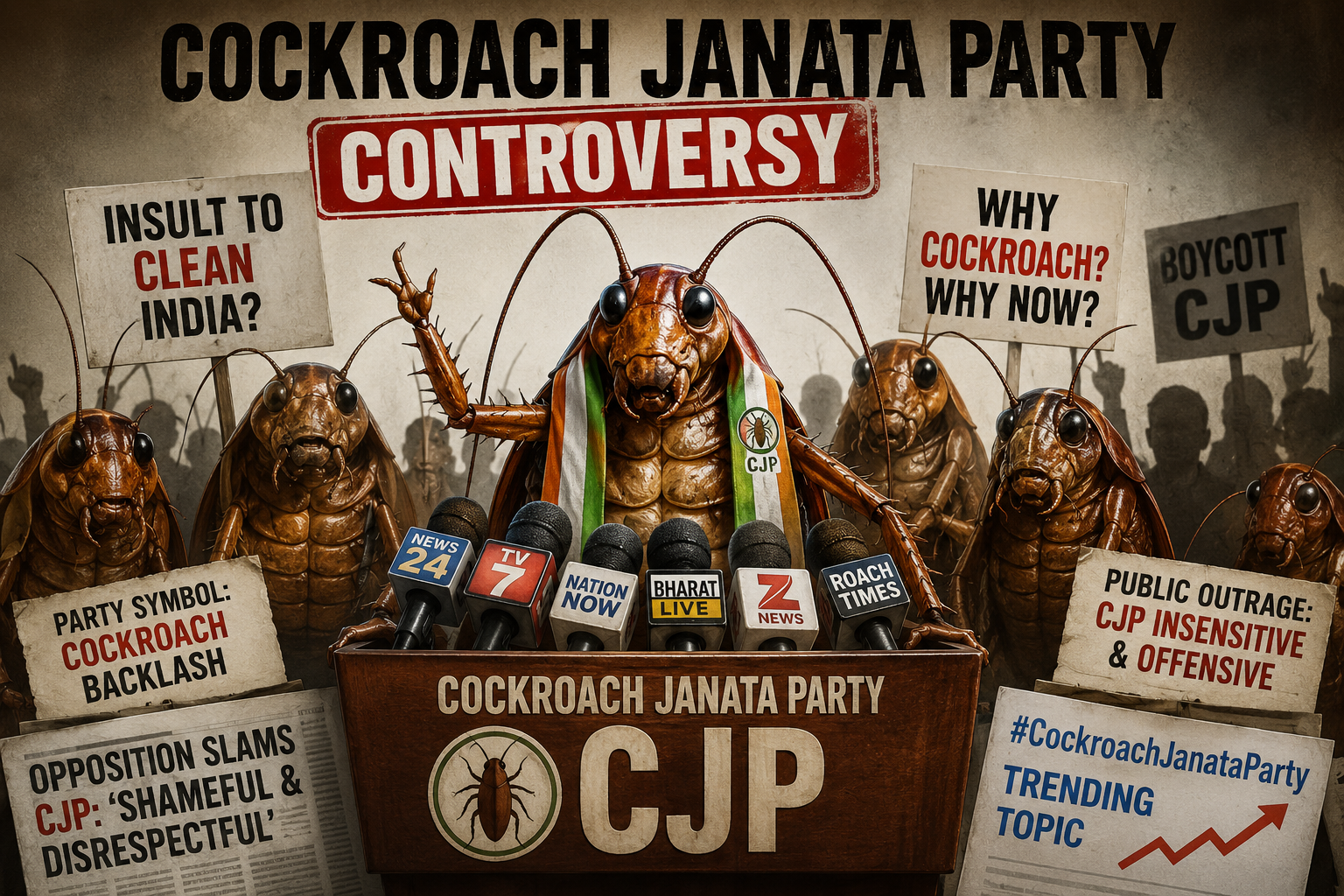
Cockroach Chronicles: Has the Right to Satire Been Withheld in India?
Examining whether the right to satire has been withheld in India through statutory provisions and landmark judicial pronouncements
The right to satire has not been withheld in India. On the contrary, the Supreme Court has consistently and robustly protected it as an integral facet of Article 19(1)(a) of the Constitution. However, this right is qualified—satirical expression remains subject to reasonable restrictions under Article 19(2) on grounds including decency, morality, defamation, public order, and incitement to an offence. The tension between creative freedom and regulatory restraint continues to shape India's free speech jurisprudence.
Constitutional Framework Governing Satirical Expression
Article 19(1)(a) guarantees all citizens the right to freedom of speech and expression. This constitutional guarantee extends to satire, humour, cartoons, films, web-series, stand-up comedy, poetry, and all forms of artistic and creative expression. The framers of the Constitution recognised that a democratic society thrives on the free exchange of ideas, including those expressed through wit, irony, and parody.
Article 19(2) permits the State to impose by law only reasonable restrictions on this right, and exclusively for one or more of the following exhaustive grounds: sovereignty and integrity of India, security of the State, friendly relations with foreign States, public order, decency or morality, contempt of court, defamation, or incitement to an offence. The Constitution Bench in Kaushal Kishor v. State of Uttar Pradesh [(2023) 4 SCC 1] emphatically held that the grounds enumerated in Article 19(2) are exhaustive—no restriction can be imposed on free speech on grounds outside this statutory framework.
Statutory Framework Affecting Satire
| Section 292 IPC| Section 294, BNS | Sale/transmission of obscene material |
| Section 499/500 IPC | Section 356, BNS | Defamation |
| Section 153A IPC| Section 196, BNS | Promoting enmity between groups |
| Section 67, IT Act, 2000 | Obscenity in electronic form |
| Section 67A, IT Act, 2000 | Sexually explicit content in electronic form |
| Section 66A, IT Act | Struck down (Shreya Singhal) | Offensive messages (void) |
Section 67 of the Information Technology Act, 2000 punishes publication or transmission of material that is "lascivious or appeals to the prurient interest" or tends to "deprave and corrupt" persons likely to see it. Section 67A punishes transmission of "sexually explicit act or conduct." Both provisions have been read down by the courts to exclude satirical and artistic content that does not meet the legal threshold for obscenity.
Judicial Recognition of Satirical Expression
The Supreme Court recognised as early as 1970 that creative and artistic expression, including satire and humour, enjoys constitutional protection. In K.A. Abbas v. Union of India [(1970) 2 SCC 780], the Court acknowledged that prior restraint through censorship must satisfy the test of strict necessity. The judgment established that film censorship, when exercised, must be guided by clear standards and cannot be arbitrary.
The Court further elaborated on the relationship between artistic expression and public interest in S. Rangarajan v. P. Jagjivan Ram [(1989) 2 SCC 574], where it was held that the threat of violence by those opposed to a film's exhibition cannot justify its suppression. This principle has profound implications for satirical content that may attract hostile reactions from offended groups.
The anticipated danger should not be remote, conjectural or far-fetched. It should have proximate and direct nexus with the expression. The expression of thought should be intrinsically dangerous to the public interest. In other words, the expression should be inseparably locked up with the action contemplated like the equivalent of a spark in a power keg.
The Scope of Reasonable Restrictions
The seminal judgment in Shreya Singhal v. Union of India [(2015) 5 SCC 1] marked a watershed moment for free speech jurisprudence in India. While primarily addressing the constitutionality of Section 66A of the Information Technology Act, the Court's reasoning has significant implications for satirical expression online. The Court struck down the provision as vague and overbroad, emphasising that mere discussion or advocacy, even through satirical means, cannot be criminalised unless it incites imminent lawless action.
In Life Insurance Corpn. v. Manubhai D. Shah [(1992) 3 SCC 637], the Supreme Court underscored that the right to propagate ideas includes the right to publish and circulate them. This principle extends to satirical content that challenges prevailing norms or critiques those in positions of power. The judgment reaffirmed that freedom of speech and expression is the bedrock of democratic governance.
Protection Against State Overreach
S. Rangarajan v. P. Jagjivan Ram [(1989) 2 SCC 574] The foundational case on artistic expression. The Court held that the State has a positive duty to protect freedom of expression even against threats of demonstration or violence. Restrictions must be necessary, not merely expedient. The "likely danger" test requires that the danger of public disorder be imminent and grave — mere apprehension is insufficient. This case originated from a satirical film on caste-based reservations.
The case of Director General, Doordarshan v. Anand Patwardhan [(2006) 8 SCC 433] addressed the rights of documentary filmmakers whose work contained satirical and critical elements. The Court held that the State cannot refuse to broadcast content merely because it is critical of government policies or expresses dissenting views. The judgment established that public broadcasters have a duty to present diverse viewpoints, including those expressed through satirical or critical formats.
In Indibility Creative Pvt. Ltd. v. Government of West Bengal [(2020) 12 SCC 436], the Supreme Court intervened to protect the release of a film that faced obstruction from state authorities. The Court's approach demonstrated that administrative action designed to suppress satirical or critical content will face strict judicial scrutiny.
Contemporary Developments and Emerging Challenges
In Apoorva Arora v. State (Govt. of NCT of Delhi) [2024] 3 SCR 1147, a 2024 judgment on the web-series College Romance that used profane language. The Court held that vulgarity and profanity are distinct from obscenity. Expletives alone do not attract Sections 67/67A of the IT Act. The Court rejected the High Court's use of "impressionable minds" as the test — the correct standard is that of the reasonable adult person, not the hypersensitive or weak-minded individual. Satirical content that uses strong language but does not arouse sexual thoughts is not obscene.
The 2024 judgment in Nipun Malhotra v. Sony Pictures Films India Pvt. Ltd. [2024] 7 SCR 246 addressed the delicate balance between creative freedom and the rights of individuals who may be affected by satirical portrayals. The Court's analysis provides important guidance on the boundaries of acceptable satire, particularly when it intersects with issues of dignity and non-discrimination.
In Imran Pratapgadhi v. State of Gujarat (2025), the most emphatic recent protection of satire. Justice Abhay S. Oka and Justice Ujjal Bhuyan held:
"Literature including poetry, dramas, films, stage shows including stand-up comedy, satire and art, make the lives of human beings more meaningful... Sometimes, we, the Judges, may not like spoken or written words. But, still, it is our duty to uphold the fundamental right under Article 19(1)(a)."
The Court laid down that when offences like Section 196 BNS (promoting enmity) are alleged, the effect of words must be judged by the standards of reasonable, strong-minded, firm and courageous individuals, not by those with weak and oscillating minds. Also: "75 years into our republic, we cannot be seen to be so shaky on our fundamentals that mere recital of a poem or... stand-up comedy, can be alleged to lead to animosity or hatred."
Therefore
1. Satire is constitutionally protected under Article 19(1)(a) as a mode of expression.
2. CBFC certification is a safe harbour — the State cannot impose extra-constitutional bans on certified content.
3. Profanity ≠ obscenity — vulgar language alone does not attract obscenity laws; the test is whether material appeals to prurient interest.
4. The "reasonable person" standard applies — courts must not apply the standards of hypersensitive or weak-minded individuals.
5. Marginalised groups receive heightened protection — satire that stereotypes, misrepresents, or disparages already vulnerable groups may be restricted.
6. Section 66A is dead — the chilling effect doctrine protects online satire from vague penal provisions.
7. Article 19(2) is exhaustive — no new grounds for restricting satirical speech
Conclusion: A Living Right
The right to satire in India remains very much alive, protected by constitutional guarantee and judicial precedent. The Supreme Court's jurisprudence demonstrates a consistent commitment to preserving space for satirical expression as a vital component of democratic discourse. However, practitioners and content creators must remain cognizant of the reasonable restrictions framework, understanding that the freedom to satirise carries with it the responsibility to avoid crossing into unprotected territory such as defamation or incitement to violence.
As new forms of media emerge and satirical expression finds novel platforms, courts will inevitably face fresh challenges in delineating the boundaries of this fundamental right. The established principles—exhaustive grounds for restriction, the requirement of proximate nexus to public harm, and the presumption in favour of free expression—provide a robust framework for resolving these future disputes.
Authorities cited
S. Rangarajan v. P. Jagjivan Ram [(1989) 2 SCC 574]
Kaushal Kishor v. State of Uttar Pradesh, (2023) 4 SCC 1
K.A. Abbas v. Union of India, (1970) 2 SCC 780
S. Rangarajan v. P. Jagjivan Ram, (1989) 2 SCC 574
Shreya Singhal v. Union of India, (2015) 5 SCC 1
Life Insurance Corpn. v. Manubhai D. Shah, (1992) 3 SCC 637
Director General, Doordarshan v. Anand Patwardhan, (2006) 8 SCC 433
Indibility Creative Pvt Ltd v. Govt of West Bengal, (2020) 12 SCC 436
Apoorva Arora v. State (Govt. of NCT of Delhi), [2024] 3 SCR 1147
Nipun Malhotra v. Sony Pictures Films India Pvt Ltd, [2024] 7 SCR 246
Imran Pratapgadhi v. State of Gujarat (2025)
Comments
Leave a comment
Comments are reviewed before publishing.